
You launch ads on Facebook and Google.
You spend ₹10,000… ₹20,000… maybe more.
Clicks start coming in. Website traffic increases.
But sales?
Almost zero.
If this sounds familiar, you’re not alone. This is one of the most common and frustrating experiences for business owners, marketers, and bloggers running paid ads.
And here’s the truth most people don’t realize:
The problem is usually not your ad.
The problem is where your ad is sending people.
Most paid ads fail because there is no marketing funnel behind them.
What Paid Ads Are Actually Meant to Do
Many people believe ads exist to generate instant sales.
They don’t.
The real purpose of paid ads is to:
- Bring new people (cold traffic) to you.
- Create awareness
- Start a relationship
- Move people step-by-step toward a purchase.
But most businesses expect this unrealistic path:
Click Ad → Visit Website → Buy Immediately.
This rarely works with people who have never heard of you before.
And this is where most ad strategies break down.
Why Sending Traffic to a Homepage or Sales Page Fails
When someone clicks your ad, they don’t know:
- Who you are
- Why they should trust you
- Whether your product is right for them
Yet most ads send visitors to:
- Homepage
- Product page
- Service page
- WhatsApp number
This creates confusion, not conversions.
You’re asking for a decision before building trust.
Landing Page vs Funnel: The Big Misunderstanding
Many marketers think:
“I have a landing page. That’s enough.”
It’s not.
- A landing page asks for a decision.
- A funnel guides the visitor toward that decision.
Without a funnel, visitors leave because:
- They’re not ready
- They don’t trust you yet.
- They need more information.
- They get distracted
This is the core reason why ads don’t convert.
What Is a Marketing Funnel?
A marketing funnel is a step-by-step journey that turns strangers into customers.
Instead of asking for a sale immediately, a funnel:
- Educates
- Builds trust
- Shows value
- Then asks for the sale.
This is the foundation of a strong ad conversion strategy.
The Psychology of Cold Traffic vs Warm Traffic
Understanding this is critical for any sales funnel built for ads.
Cold Traffic
These people:
- Have never heard of you
- Don’t trust you
- Are not ready to buy
- Need education first
Warm Traffic
These people:
- Know your brand
- Have consumed your content
- Trust you more
- Are much more likely to buy
Ads usually bring cold traffic.
But businesses treat them like warm traffic.
That mismatch kills conversions.
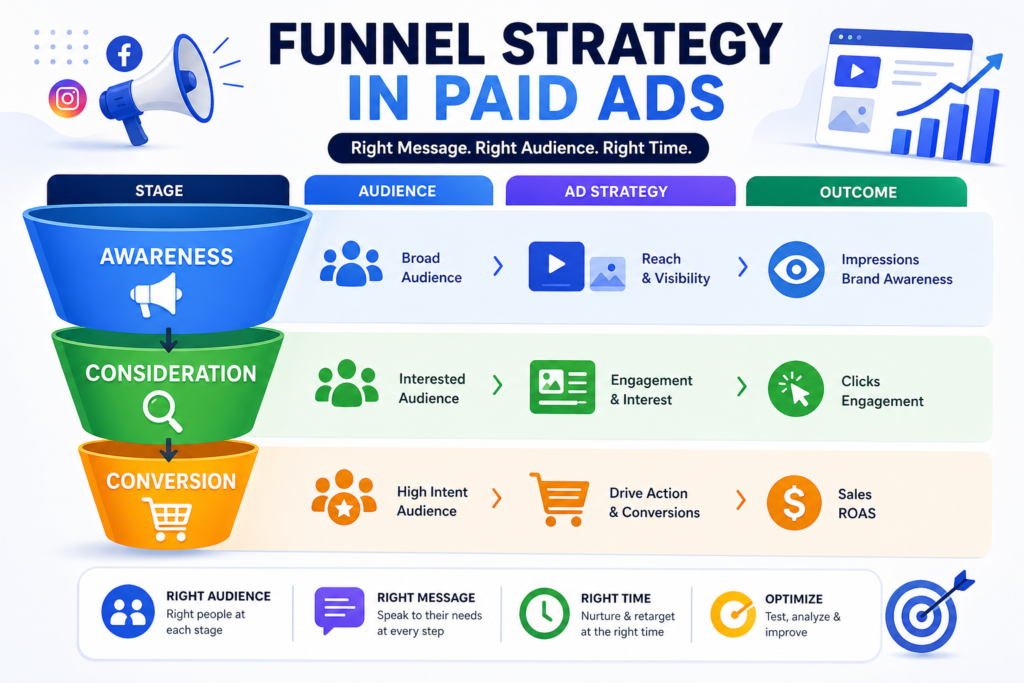
The 4 Stages of a Funnel for Paid Ads
A proper ad funnel (whether from Facebook or Google) follows four simple stages.
1. Awareness
Goal: Introduce yourself and provide value.
Examples:
- Free guide
- Free checklist
- Free video
- Free ebook
Ad → Lead Magnet Page
2. Interest
Goal: Build trust and authority.
After they sign up:
- Email sequence
- Educational content
- Problem-solving tips
- Case studies
Now they start knowing you.
3. Consideration
Goal: Show how your product/service solves their problem.
- Testimonials
- Demo
- Comparisons
- Clear benefits
They are now warm.
4. Conversion
Now you ask for the sale.
Because trust exists, conversion rates increase dramatically.
Common Mistakes That Kill Ad Performance
These mistakes ruin most paid ad efforts:
- Sending traffic to the homepage
- Asking for a sale too early
- No lead magnet
- No email follow-up
- No retargeting ads
- Expecting instant ROI
- Ignoring cold traffic psychology
How to Build a Simple Funnel for Paid Ads (Step-by-Step)
You don’t need expensive software or complex systems.
Step 1 – Create a Lead Magnet
Examples:
- Free PDF
- Free video
- Free template
- Free audit
Something genuinely valuable.
Step 2 – Create a Simple Landing Page
This page should:
- Explain the benefit of the free offer.
- Collect name and email.
- Remove all distractions
Step 3 – Set Up Email Follow-Up
Send 5–7 emails:
- Deliver the freebie
- Provide value
- Share your story
- Show proof
- Introduce your offer
Step 4 – Run Ads to the Lead Magnet Page
This becomes the entry point of your ad funnel using tools like Meta Ads Manager and Google Ads.
Step 5 – Retarget Visitors
Run ads only to:
- People who visited your page
- People who opened emails
These are warm audiences. Conversions happen here.
Simple Tools You Can Use to Create Funnels
You don’t need costly tools. This basic stack is enough:
- WordPress – Landing pages
- Mailchimp – Email automation
- Google Ads – Search ads
- Meta Ads Manager – Social ads
- Canva – Lead magnet design
Why Funnels Increase Ad ROI Dramatically
With a funnel:
- You collect leads even if they don’t buy
- You can follow up later.
- You build your own audience.
- You reduce ad waste
- You convert cold traffic into warm buyers.
This is the ad conversion strategy professionals use.
Conclusion: Don’t Run Ads Without a Funnel
If you are running ads without a funnel, you’re essentially donating money to ad platforms.
Paid ads are powerful.
But only when supported by a marketing funnel.
Before you spend your next rupee on ads:
- Create a lead magnet.
- Build a simple funnel.
- Set up email follow-up.
- Then run ads
You’ll see the difference almost immediately.