
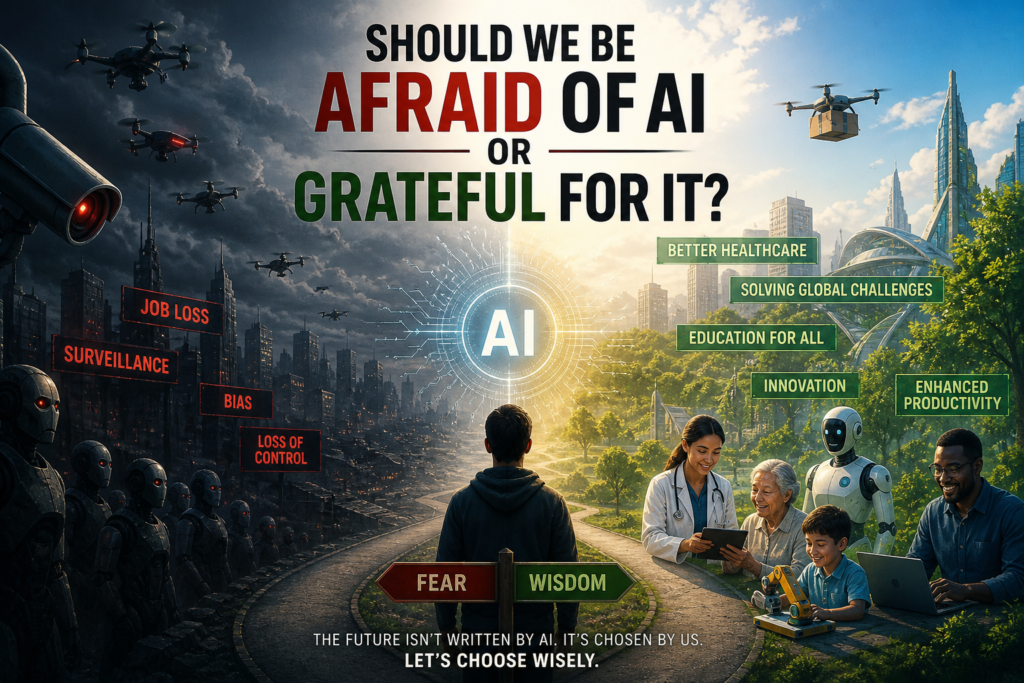
Every morning, millions of people open their laptops and type a prompt into an AI tool. A blogger in Chennai drafts a week’s content before breakfast. A solo graphic designer in Lagos produces brand visuals that once required a full creative agency. A small business owner in Manchester writes professional marketing copy without hiring a copywriter.
This is not a vision of the future. This is 2025.
Artificial intelligence has moved from research labs into everyday work at a speed that even its architects did not fully predict. And with that speed has come an urgent, deeply human question: should we be afraid of AI or grateful for it?
The honest answer, as this report will show, is that the question itself may be the wrong one to ask.
How Quickly Did AI Enter Our Working Lives?
In 2022, fewer than 20% of knowledge workers regularly used AI-assisted tools. By early 2025, that figure had crossed 60% in industries like marketing, media, and content creation, according to McKinsey’s annual State of AI report. Canva introduced AI image generation. Notion built AI writing directly into its interface. Google Docs began auto-suggesting entire paragraphs.
The shift happened not through corporate mandates, but through individual adoption, one person at a time, realising a tool could save them hours.
“Tasks that once took a full afternoon, research, draft, edit, and design can now be completed before lunch.”
For digital creators and small business owners, especially, this compression of time has been transformative. But transformation, by its nature, unsettles as much as it enables.
The Fears Are Real and Worth Taking Seriously
Dismissing concerns about AI as technophobia would be intellectually dishonest. The fears people carry about artificial intelligence are grounded in observable patterns, not panic.
Job Displacement: A 2024 Goldman Sachs analysis estimated that AI could automate tasks equivalent to 300 million full-time jobs globally. Writers, junior designers, customer support agents, and data entry clerks are already seeing their roles restructured. The question is not whether AI will change the job market; it is how fast, and who will bear the cost.
The Homogenisation of Creativity. When millions of creators use the same AI models trained on the same datasets, there is a genuine risk that content begins to converge on the same sentence structures, the same visual aesthetics, the same headline formulas. Originality requires conscious effort when your assistant has read everything ever written.
Misinformation at Scale AI-generated images, audio deepfakes, and synthetic text have already been deployed in political disinformation campaigns. In 2024, AI-generated robocalls mimicking a U.S. presidential candidate’s voice were used to suppress voter turnout in a primary election. The technology to deceive is now accessible to anyone with an internet connection.
Cognitive Dependency There is a quieter fear, less discussed but perhaps more insidious: that over-reliance on AI will erode deep thinking. If we outsource analysis, synthesis, and even curiosity to machines, what happens to the human capacity that made those machines possible?
The Opportunities Are Equally Real
Against these concerns stands a remarkable counterweight: AI has democratised capability in ways previously unimaginable.
Consider what it now means to start a content business with limited resources. A decade ago, a solo creator needed to be a writer, editor, SEO analyst, graphic designer, and social media strategist — or hire each of those roles separately. Today, AI tools can assist across all of them, lowering the barrier to entry dramatically.
“AI has not just automated tasks. It has redistributed power, moving it away from agencies with large budgets and toward individuals with good ideas.”
For first-generation entrepreneurs, non-native English speakers, and creators in developing markets, this redistribution is not a minor convenience. It is a structural shift. A talented marketer in Nairobi or Jakarta now has access to the same AI-powered research and writing tools as a consultant in New York.
What the Evidence Suggests About Human-AI Collaboration
The most instructive data does not come from either the AI optimists or the doomsayers; it comes from workplaces that have studied human-AI collaboration systematically.
A 2023 study by MIT economists Brynjolfsson, Li, and Raymond examined customer support agents using an AI assistant. The findings were nuanced: AI assistance improved the productivity of newer, less experienced workers by 35%, while having a smaller effect on seasoned experts. The implication? AI amplifies existing competence rather than replacing it wholesale.
A separate study by Harvard Business School, published in 2024, found that consultants using AI produced higher-quality outputs on structured tasks but that AI actually reduced performance on tasks requiring novel, creative problem-solving when users leaned on it too heavily.
The pattern that emerges is consistent: AI is a force multiplier, not a replacement. But like any powerful tool, it rewards skilled use and punishes blind dependence.
How to Use AI Without Losing What Makes You Valuable
For creators, marketers, and business owners navigating this landscape, a few principles have emerged from practice:
- Use AI for structure, not for substance. Let AI organise your thinking outlines, research summaries, and draft frameworks. The ideas, the angles, the genuine insights should come from you.
- Treat AI outputs as first drafts, not final copy. AI prose tends toward the generic. Your job is to make it specific — with your experience, your examples, your voice.
- Invest in prompt craft. The quality of what AI produces is a direct function of the quality of your instructions. Learning to prompt well is now a core professional skill.
- Preserve space for deep thinking. Schedule time without AI assistance for the work that requires a genuine synthesis strategy, original creative concepts, and complex judgment calls.
- Stay critical of AI-generated information. AI models hallucinate facts, misattribute quotes, and confuse dates. Always verify before publishing.
So – Afraid or Grateful?
The framing of this question, it turns out, is the problem.
Fear and gratitude are not opposites. They are both appropriate responses to genuine power. We are afraid of fire and grateful for it. We are afraid of the sea and grateful for it. The same logic applies to artificial intelligence.
Fear, applied well, produces caution in regulation, in deployment, in personal habits. Gratitude, applied well, produces adoption in learning, in building, in reaching people and markets previously out of reach.
“The creators who will define the next decade are not the ones who fear AI or the ones who blindly trust it. They are the ones who understand it well enough to use it wisely.”
Conclusion
Artificial intelligence is already reshaping how content is created, how businesses operate, and how individuals compete in the digital economy. That reshaping is neither entirely benign nor entirely threatening; it is, like most significant technologies, a mirror of the intentions and skills of those who use it.
For the beginner building their first online brand, AI is a collaborator that levels the playing field. For the experienced professional, it is an accelerator. For the reckless or the uncritical, it is a liability.
The question worth asking is not whether to fear or celebrate AI. It is: what kind of user do you intend to be?